Saturday, December 27, 2008

WoundStat Update

After only recently announcing that Z-Medica's Combat Gauze, and another hemostatic product called WoundStat were the new standard for Tactical Combat Casualty Care, the Army has pulled one of them following the 2008 Special Operations Medical Association conference.
WoundStat was found to have a severe risk of causing occlusive thrombosis (clotting leading to blockage), deeper inside the body than simply at the wound site. The Army has issued directives for all WoundStat to be turned in, and it's use to be discontinued pending further testing.

I'll post two bits that were passed along to me via email regarding this.
First, the FRAGO that went out regarding discontinuation of WoundStat:
FROM
CDRUSAMMA FT DETRICK MD//MCMR-MMO-SO//

***PRIORITY***MESSAGE NOT RELEASED

****************UNCLASSIFIED****************

SUBJ: T0B-1218-002
NEW SOLDIER HEMOSTATIC DRESSINS / WOUNDSTAT / MEDICAL INFORMATION


REFERENCE: ALARACT 239/2008, NEW SOLDIER HEMOSTATIC DRESSINGS

1. THIS FRAGO DIRECTS TEMPORARY CESSATION OF USE OF WOUNDSTAT™ (WS) BY 68W
COMBAT MEDICS AND ALL OTHER PROVIDERS DUE TO NEWLY IDENTIFIED SAFETY CONCERNS
ABOUT THIS PRODUCT, PENDING FURTHER EVALUATION.

2. WOUNDSTAT™ WILL BE TURNED IN TO THE MEDICAL SUPPLY SYSTEM IMMEDIATELY.
UNIT SUPPLY PERSONNEL WILL TURN -IN WOUNDSTAT™ TO THEIR SUPPORTING MEDICAL
SUPPLY SUPPORT ACTIVITY (SSA). THE ARMY MEDICAL SSA WILL REVIEW TRANSACTION
REGISTERS AND COMPLETE 100% CONTACT WITH UNITS ISSUED WS TO ENSURE TURN-IN
OF PRODUCT. ARCENT WILL SUBMIT THE TOTAL NUMBER OF WS ISSUED AND COLLECTED
TO OTSG. THE ARMY MEDICAL SSA WILL HOLD WS UNTIL FURTHER NOTICE OR UNTIL DISPOSITION
INSTRUCTIONS ARE RECEIVED FROM OTSG.

3. DATA FROM THE US ARMY INSTITUTE OF SURGICAL RESEARCH (USAISR) SHOW THAT
WS IS ASSOCIATED WITH A HIGH INCIDENCE OF BLOOD VESSEL THROMBOSIS AND DAMAGE
TO THE VESSEL WALL. COMBAT GAUZE AND PLAIN KERLIX WERE NOT ASSOCIATED WITH
SIMILAR FINDINGS. USE OF COMBAT GAUZE IS SAFE, ACCORDING TO CURRENT STUDIES,
AND DISTRIBUTION AND USE SHOULD CONTINUE.

4. MEDICAL PERSONNEL MUST LOCATE AND EXAMINE ALL CASUALTIES PREVIOUSLY TREATED
WITH WS TO VERIFY ADEQUATE LIMB PERFUSION, IF WS WAS USED TO TREAT EXTREMITY
WOUNDS.

5. EXPIRATION DATE CANNOT BE DETERMINED.


And, an email originating from Frank Butler (whose name should be immediately familiar if you've been doing your homework):
-----Original Message-----
From: Butler, Frank K., CTR [mailto:[redacted]@med.navy.mil]
Sent: Wednesday, December 24, 2008 12:35 PM
Subject: WoundStat Message

Forwarded FYI.

The attached message reflects safety concerns about WoundStat presented by
Dr. Bijan Kheirabadi from the U.S. Army Institute of Surgical Research at
the recent Special Operations Medical Association conference.

Dr. Kheirabadi observed that 7 of 8 animals on whom WoundStat was used in a
carotid artery bleeding model developed occlusive thrombosis and had no
blood flow 2 hours after suturing of the wound.

The implications of this study for both WoundStat and hemostatic agent
testing in general are currently under review.

Note that WoundStat currently serves as the "Last Resort" of medics' options
to stop life-threatening external hemorrhage. TCCC guidelines call for
tourniquets, Combat Gauze, and WoundStat in that order. When used
appropriately, WoundStat is the medic's last intervention to stop a casualty
from bleeding to death from external hemorrhage in a location not amenable
to tourniquet use.

V/R -

Frank

Frank K. Butler, Jr. M.D.
CAPT MC USN (RET)
Chairman
Committee on Tactical Combat Casualty Care


The summary of Dr. Kheirabadi's presentation should be up on the SOMA site sometime in the near future.
Further testing and independent evaluations will undoubtedly happen, and will either put the final nails in WoundStat's coffin, or possibly out it as safe for use with an improved protocol.
Until I hear differently however, WoundStat is off my list. Fortunately, I dont own any, but was thinking about adding some given its 100% effectiveness in testing. As of now, however, WoundStat is a no-go.
Sticking to Z-Medica (QuickClot) Combat Gauze, and QuickClot Sponges.

Tuesday, December 16, 2008

A Lesson on Combat Knives, in Two Parts: The MOD XSF-1, and the Mil-Tac CS1


The MIL-TAC Combat Survival 1 (Left) and the Blackhawk XSF-1 (Right)

There is, in the knife community, an undue fascination with “fighting” and “combat” knives. Lots of collectors, enthusiasts, and makers specialize in these types of blades. Some of them are fine people, but most with an interest in, or god save us an opinion on, such knives lack the weight of need or experience to lend their ideas validity. Yet it is often this lot who have their voice raised above those of the truly experienced and it is their cacophony which drives a large part of the "tactical" knife world. Not because they are right, but often because they have, if nothing else, immense buying power.
However, there remain voices and talents in the industry who, on the weight of their background or the strength of their products, have every right and reason to speak up. Not that they always do, some of these talents seem to prefer letting their products do the talking, and keep their voices low. Some are out-spoken, and on the vocal forefront of the industry, but have earned their place there. In either case it is to these talents that people of an experienced need and background go for cutlery. They do so trusting that what they are buying is not hype, is not a “name”, is in fact nothing but a well designed, well executed performance tool.
These opposing forces are not in balance however. The demand for knives to suit the enthusiast market is much higher than for knives to actually be used, particularly in the “tactical” field. There is money to be made from the fancy, the different, the new and shiny. Hype and gadgetry have made more people money than reliability and proven forms, and manufacturers know this. And from time to time, even those who should know better, fail and fall. But as one falls, another rises.

Thursday, December 11, 2008

Foundations

I've been gathering video material from the web for reference, and thought I might This is more of a reference post for myself and the local wrecking crew, but it should be interesting to others as well.
This has relationships to a lot of the work we've been doing lately, that will hopefully generate some interesting footage as well at some point.

In Fight Weapons Access Arm Pass: http://www.vimeo.com/1100865 (An essential IFWA component, presented by ShivWorks/"SouthNarc")

ShivWorks ECQC Class: http://www.vimeo.com/1072283

A collection of ECQC Evolutions: http://www.youtube.com/user/soonerbjj

DashCam video of ECQ Shooting and Fight: http://www.nothingtoxic.com/media/1162877455/Small_Cop_Takes_on_a_Former_Heavyweight_Fighter (NSFW content in sidebar ads)

Off-Duty Cop ECQ Shooting: http://www.liveleak.com/view?i=175_1216836804

Tuesday, November 18, 2008

A Proposed Guideline...

A Proposed Guideline for Tactical Medical Self-Care in the Civilian Environment:
by Morgan Atwood, © Not For Redistribution w/o Permission & Attribution

Overview:

In environments involving violent use of firearms, knives, and other weapons capable of inflicting life threatening penetrating trauma (which we might call Tactical Environments for lack of a better term), there exists a need for medical management guidelines specifically addressing the unique concerns of said environment. The military and police communities have addressed this with adoption of the military generated Tactical Combat Casualty Care guidelines. Recognition of the risk of injury in the tactical environment, and the need for improved, tactically sound, care methods for those engaged in violent encounters has slowly begun seeping into the civilian context of armed/self-protection minded citizens. What information exists, however, is generally gleaned from the documents and training created around the military/police contextual model, which differs significantly from that of the armed citizen engaged in self defense.
The civilian environment lacks the protections afforded by operating in small units which can provide suppressive fire to protect dedicated medics, and members of which generally wear body armor and protective equipment. Injury sustained in the civilian environment must be self stabilized, for lack of better options, until professional care arrives. The safety and security of the environment in which the care is delivered is also up to the individual most likely suffering the injury. The armed citizen is triple-tasked to negate active threats, use cover and effective fire (not volume) to secure themselves, and provide their own care for stabilization of a life threatening injury in the “Platinum 10-minutes” after it occurs. This demand for self-care is only heightened by the inevitable delay in arrival of emergency medical services, given response times and the need for police to declare a scene secured prior to EMS entering.
Meeting the needs of medical care in civilian engagements can be accomplished via the first two stages of Tactical Combat Casualty Care: Care Under Fire and Tactical Field Care. The third stage, Casualty Evacuation, is handled by the arrival of EMS, and is of far less concern than self stabilization in the immediate aftermath of violent penetrating trauma.

(Complete Document after the Jump:)

Monday, November 10, 2008

A New Beginning

For several years I operated a website and blog under the Combative Concepts header. As time went on, I begin to harbor more and more unhappiness over that moniker for a variety of reasons. Firstly, the name became extremely limiting. As things evolved and my interests and skills expanded, some of the territory I wanted to cover was outside the small area dictated by that name. Wilderness survival, hard-use outdoor equipment, and related concerns weren't necessarily "combative". Secondly, I wasn't the first the operate under that name, though I was unaware of that when I created the first dot com and blog.
After taking a few years off, I found myself with a new training group, and working on fresh ideas. The developmental path this group had ended up taking was very much an evolution of my thinking at the end of the Combative Concepts endeavor. I had, we had, created something new and it was time to move on from the restrictions of the past. Thus, BFE Labs was born.
The name came about in part thanks to Ian Wendt, of Special Circumstances, and his suggestion that a joking crack I had made would actually be a good name for this project.
The acronym BFE stands for "Bum Fuck Egypt", a generalized concept of anywhere that is pretty much nowhere - Isolated, alone, austere, and possible hostile. The exact environments we have in mind for most of the work we do.

I have moved a few of the old Combative Concepts entries into this new blog, and once the dot com is up and running will move some of the old CC articles over there as well. Anything dated earlier than 2008 is from the Combative Concepts era - It is dated, some of my thinking has grown since then, and the BFE group is headed into new directions. That said, a lot of it is still worth reading, in my opinion, and as such it remains available.

Thursday, March 30, 2006

Is Stainless Steel Good Enough for a Knife Blade?

As a knife-maker, and the moderator of knife (or knife related) forums for a few different internet bulletin boards over recent years, I very often hear people talking about high carbon steel being the only choice for a good knife. If they don’t say it directly, it is often something they have heard from someone else, saying something like “I was told if a steel doesn’t rust it wont make a good knife.”
Of course the up-shot of this is very often that stainless steel gets pandered, even unintentionally, and very good knives made of stainless are ignored or over looked. This is quite unfortunate, because the right stainless steel works extremely well.

I have a theory about this little phenomenon though - It is an issue of Carbon content.

Before we continue, let me establish a few “definitions”. Steel, in general, is divided up into two categories, and five subcategories that apply to the two main ones:

  • Simple Carbon Steel – Steel of all types with less than 13% Chromium content.
  • Stainless Steel – Steel of all types with more than 13% Chromium content.

Ø Very Low Carbon – Steel with up to 0.05% carbon content.

Ø Low Carbon – Containing 0.05 – 0.2%

Ø Medium Carbon – Containing 0.2 – 0.5%

Ø Medium-High Carbon – Containing 0.5 – 0.8%

Ø High Carbon – Containing 0.8% and higher

The higher the carbon content the better, but we’ll get to that momentarily.

Now, in the knife world the term “High Carbon” alone takes on its own meaning – it is used to indicate a high carbon, Non-Stainless, blade steel. Stainless, or high carbon stainless, is the commonly used term for stainless steel blades.

The old-school wisdom about blade-steels having to be High Carbon steel probably comes from a combination of two things - early stainless steels having low carbon content (a hypothesis on my part, I am not a historical metallurgist), and cheap knives being made from poor (low carbon content) stainless steels.

You have a historical precedent of old-school bladesmiths and knife-makers saying "That new fangled stainless doesn’t make a good knife", combined with a current perception of stainless as a poor steel thanks to low quality knives. Although the latter is primarily supported by el cheapo Pakistani and Chinese imports, major companies such as Buck, Case, the now defunct Schrade, and Gerber, who are to a large extent makers of the knives carried by "the common man", use low grade stainless steels, that give poorer performance compared to the carbon steel of the knife the user may have carried before, or of a similar high carbon steel bladed offering.

Here's the difference between stainless and non-stainless (high carbon) steels, chromium. Anything less than 14% chromium, and its a carbon steel - over 14%, its not. That’s it. The chromium content has some impact on the quality of the steel as a knife blade, but comparatively little next to carbon content. Carbon content makes all the difference in the world. A good quality stainless steel, in addition to having the stain resistant (no steel is truly rust or stain "less") qualities provided by the Chromium content of the alloy, must also have a high carbon content.


Now, I am not a metallurgist, I’m just a knife-maker, but my understanding of this is as follows: Carbon is the essential element in hardening steel. When steel is heated to a certain temperature (this temp. will vary depending on carbon levels) the ferrite (pure iron) reacts with the carbides causing a transformation from the cold structure of the steel into a metastable state called austenite (a face centered cubic crystal with ample space for carbon atoms). As this critical temperature at which the change begins is passed more austenite pools and consumes the ferrite. When all the ferrite is consumed the steel consists of austenite and undissolved carbides. Without getting too involved here the transformation to austenite results in a new grain-structure, held by the undissolved carbides. As the heat is maintained at the critical temp (or increased for some alloys) the remaining carbide is dissolved, allowing the grain structure of the austenite to develop fully. Remember, this is a state of hot steel.
To harden, the steel in its austenite state is rapidly cooled (rapidly varies from steel to steel, and depending on the desired hardness, cooling is a controlled process, but to harden the cooling must be faster than natural heat dissipation by a considerable amount) – this cooling traps carbon atoms inside the face centered cubic structure which distorts them into a tetragonal shape that is under immense stress. This stress equals hardness. The end result of rapidly cooled austenite is called “martensite”. Without carbon, this entire process is impossible. Without the right amount of carbon, the process is possible but will never bring the steel to a hardness suitable for a knife.
(After all of the above, the hardening process, the steel is “tempered”, reheated slightly to relieve a little of the stress on the carbon atoms, and achieve a balance between necessary hardness, and toughness: the shock resistance of the steel. Too hard is also too brittle, not good for blades).
Other elements in the alloy, such as Chromium, Tungsten, Molybdenum, etc. can have their own little impacts on the hardening process, but without carbon its moot.

So how much carbon content is enough in Stainless Steel? Well, the lowest acceptable grade of stainless is generally considered 440A stainless, which has 0.60 carbon content, 440B has 0.70 and good old 440C has 0.95 – 1.20. Comparatively, 420J2 (which is the industry standard for Chinese junk knives) has only 0.15 – lending to the perception of stainless as a low carbon poor quality steel.
Industry standards for stainless tactical knives (especially at the custom level) are ATS-34, 154-CM and S30V.
ATS-34 and 154CM are pretty much the same steel although they differ in manganese content, one is simply a Hitachi product and the other from an American mill (Crucible, maybe, but I do not remember), their carbon content is the same 1.05
S30V has a carbon content of 1.45 (which is similar to the carbon content of top-end High Carbon tool steels, such as D2 [which is near a stainless, but just not quite enough Cr.]).
The best stainless blade steels are ones with a carbon content of 0.90 or greater. These steels are capable of achieving good hardness, for long term edge holding and performance, and if properly handled during hardening and tempering are also tough in addition to their wear resistance.

That’s a pretty quick (yeah right!) and dirty summation of how it works, so if there are any metallurgists here forgive me for any errors.

Folding Utility Knives


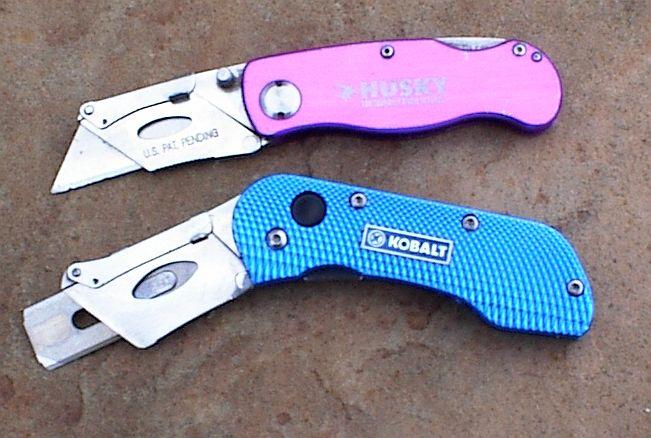
The folding utility knife is nothing new - its been around for awhile, with some pretty good quality ones having come out in the past couple of years. I think the first one I was aware of was the SuperKnife, which is probably still the best quality of them on the market, but there are several different brands out there now. Including several, of essentially the same type, that are being logo-branded by tool companies like Husky, or Kobalt, and sold cheaply in big-box hardware stores like Lowes.
I've had one of these, a Husky labeled utility knife, for awhile now and use it to cut assorted stuff around my knife making shop. Its a good tool, well made with a solid lock and a comfortable handle.
Just yesterday at Lowe's I picked up a folding Carpet Knife, with the nice double-edged razor style blade. A liner lock, this. Good lockup too.

The "low-profile" non-weapon weapons aspect of these tools is obvious; as a more concealable successor to the venerable box cutter. I have actually carried mine in the non-permissive environment on a couple of occasions. Not my first choice, but it is an option.
The box-cutter (and similar utility knives: carpet knives, linoleum knives) have long been a favored "Street weapon". I've seen more than one homeless guy with one in his back pocket and read more than one news article about some poor sap who stepped around the wrong corner and got one to the face and throat. I recall one article about a guy who got his neck sliced open by a gang member, ran all the way to the hospital hands clamped around his neck, and lived. He was fucking lucky.
In the UK a common name for edged weapons is "Stanleys" thanks to the good old Stanley box-cutter.
There is probably not a one of us that doesnt remember the role of the meager box-cutter in the 9/11 attacks.
Going back even further, I remember an old article in Tactical Knives by Bob Kasper, in the Street Smarts column (back around 1996 I'd guess), talking about the "deadly box-cutter attack". In it he talked about one of the best defenses against that type of mad-slashing attack I have seen - Hands on your head (temple area), elbows in tight (sort of a double arm version of the "Flinch "ala SouthNarc), to protect your face and neck from the slashes with that bony structure, and delivering an explosive barrage of low-line kicks, trying to break your attackers structure down. You'll get cut - but where do you get cut? The arms, elbows not the face and neck.

Every time I go to town I see several people with these folding-box cutters clipped to their pocket, usually some form of the one I have labeled Husky. Not all of these folk are the working-man looking type, the sort who would have one. I've seen more than a few "gangsta" types with these in their pockets. For all the ones I see, I have to wonder - how many dont get seen, because they know better than to be seen?
These things may be cheap, but like the older style (and still prevalent) boxcutter, they are solid and vicious weapons in determined hands. Occasionally its good to remember that.
In our training sometimes its good to put aside those big rubber A/F trainers, and use something to add a little more spice and reality to the mix. Thats why I make that folding box-cutter trainer up there, and why I keep a couple for myself.
Put some lipstick on the front 3/4" and try your disarms on that and see how you fair.