Showing posts with label Knives. Show all posts

Sunday, January 24, 2010

The ShivWorks Disciple

I carry a knife (or three) daily and have done-so since I was six years old. Beginning around age 13 or 14, I have carried knives for defensive purposes and studied knife combatives to that end. Over the years I've gone through many evolutions, beginning with “wow thats bad ass-er than the last bad ass knife I owned” before growing up to skill and knowledged needs driven selections.
Several years ago, well after I'd begun choosing knives wisely as a result of my training, I started carrying a ShivWorks Disciple. Although I have since evolved again and moved away from the Disciple, I still value the tool a great deal. It is, in my opinion, one of the best purpose-designed combative fixed blades on the market. The ShivWorks Disciple is a 7 ½” long fixed blade, with a 3 ½” blade of S30V steel. It's handle is ½” (approx.) thick with contoured G-10 scales fastened by hollow stainless pins. The exposed steel features a smooth bead-blast finish and the scales are gently textured. In the sheath the overall weight is a mere 5.5 ounces. Overall length in the sheath is only a quarter of an inch longer than the knife itself, with the widest part of the sheath being only 2”, and its thickest being 1 ¼” (including a Tek Lok™).
[More After the Jump]

Thursday, March 30, 2006

Is Stainless Steel Good Enough for a Knife Blade?

As a knife-maker, and the moderator of knife (or knife related) forums for a few different internet bulletin boards over recent years, I very often hear people talking about high carbon steel being the only choice for a good knife. If they don’t say it directly, it is often something they have heard from someone else, saying something like “I was told if a steel doesn’t rust it wont make a good knife.”
Of course the up-shot of this is very often that stainless steel gets pandered, even unintentionally, and very good knives made of stainless are ignored or over looked. This is quite unfortunate, because the right stainless steel works extremely well.

I have a theory about this little phenomenon though - It is an issue of Carbon content.

Before we continue, let me establish a few “definitions”. Steel, in general, is divided up into two categories, and five subcategories that apply to the two main ones:

  • Simple Carbon Steel – Steel of all types with less than 13% Chromium content.
  • Stainless Steel – Steel of all types with more than 13% Chromium content.

Ø Very Low Carbon – Steel with up to 0.05% carbon content.

Ø Low Carbon – Containing 0.05 – 0.2%

Ø Medium Carbon – Containing 0.2 – 0.5%

Ø Medium-High Carbon – Containing 0.5 – 0.8%

Ø High Carbon – Containing 0.8% and higher

The higher the carbon content the better, but we’ll get to that momentarily.

Now, in the knife world the term “High Carbon” alone takes on its own meaning – it is used to indicate a high carbon, Non-Stainless, blade steel. Stainless, or high carbon stainless, is the commonly used term for stainless steel blades.

The old-school wisdom about blade-steels having to be High Carbon steel probably comes from a combination of two things - early stainless steels having low carbon content (a hypothesis on my part, I am not a historical metallurgist), and cheap knives being made from poor (low carbon content) stainless steels.

You have a historical precedent of old-school bladesmiths and knife-makers saying "That new fangled stainless doesn’t make a good knife", combined with a current perception of stainless as a poor steel thanks to low quality knives. Although the latter is primarily supported by el cheapo Pakistani and Chinese imports, major companies such as Buck, Case, the now defunct Schrade, and Gerber, who are to a large extent makers of the knives carried by "the common man", use low grade stainless steels, that give poorer performance compared to the carbon steel of the knife the user may have carried before, or of a similar high carbon steel bladed offering.

Here's the difference between stainless and non-stainless (high carbon) steels, chromium. Anything less than 14% chromium, and its a carbon steel - over 14%, its not. That’s it. The chromium content has some impact on the quality of the steel as a knife blade, but comparatively little next to carbon content. Carbon content makes all the difference in the world. A good quality stainless steel, in addition to having the stain resistant (no steel is truly rust or stain "less") qualities provided by the Chromium content of the alloy, must also have a high carbon content.


Now, I am not a metallurgist, I’m just a knife-maker, but my understanding of this is as follows: Carbon is the essential element in hardening steel. When steel is heated to a certain temperature (this temp. will vary depending on carbon levels) the ferrite (pure iron) reacts with the carbides causing a transformation from the cold structure of the steel into a metastable state called austenite (a face centered cubic crystal with ample space for carbon atoms). As this critical temperature at which the change begins is passed more austenite pools and consumes the ferrite. When all the ferrite is consumed the steel consists of austenite and undissolved carbides. Without getting too involved here the transformation to austenite results in a new grain-structure, held by the undissolved carbides. As the heat is maintained at the critical temp (or increased for some alloys) the remaining carbide is dissolved, allowing the grain structure of the austenite to develop fully. Remember, this is a state of hot steel.
To harden, the steel in its austenite state is rapidly cooled (rapidly varies from steel to steel, and depending on the desired hardness, cooling is a controlled process, but to harden the cooling must be faster than natural heat dissipation by a considerable amount) – this cooling traps carbon atoms inside the face centered cubic structure which distorts them into a tetragonal shape that is under immense stress. This stress equals hardness. The end result of rapidly cooled austenite is called “martensite”. Without carbon, this entire process is impossible. Without the right amount of carbon, the process is possible but will never bring the steel to a hardness suitable for a knife.
(After all of the above, the hardening process, the steel is “tempered”, reheated slightly to relieve a little of the stress on the carbon atoms, and achieve a balance between necessary hardness, and toughness: the shock resistance of the steel. Too hard is also too brittle, not good for blades).
Other elements in the alloy, such as Chromium, Tungsten, Molybdenum, etc. can have their own little impacts on the hardening process, but without carbon its moot.

So how much carbon content is enough in Stainless Steel? Well, the lowest acceptable grade of stainless is generally considered 440A stainless, which has 0.60 carbon content, 440B has 0.70 and good old 440C has 0.95 – 1.20. Comparatively, 420J2 (which is the industry standard for Chinese junk knives) has only 0.15 – lending to the perception of stainless as a low carbon poor quality steel.
Industry standards for stainless tactical knives (especially at the custom level) are ATS-34, 154-CM and S30V.
ATS-34 and 154CM are pretty much the same steel although they differ in manganese content, one is simply a Hitachi product and the other from an American mill (Crucible, maybe, but I do not remember), their carbon content is the same 1.05
S30V has a carbon content of 1.45 (which is similar to the carbon content of top-end High Carbon tool steels, such as D2 [which is near a stainless, but just not quite enough Cr.]).
The best stainless blade steels are ones with a carbon content of 0.90 or greater. These steels are capable of achieving good hardness, for long term edge holding and performance, and if properly handled during hardening and tempering are also tough in addition to their wear resistance.

That’s a pretty quick (yeah right!) and dirty summation of how it works, so if there are any metallurgists here forgive me for any errors.

Folding Utility Knives


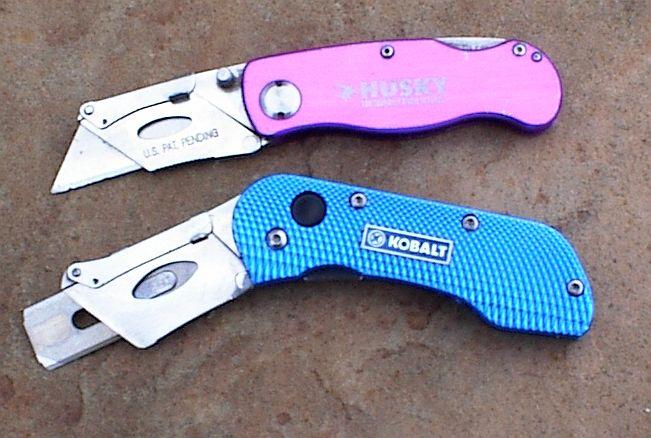
The folding utility knife is nothing new - its been around for awhile, with some pretty good quality ones having come out in the past couple of years. I think the first one I was aware of was the SuperKnife, which is probably still the best quality of them on the market, but there are several different brands out there now. Including several, of essentially the same type, that are being logo-branded by tool companies like Husky, or Kobalt, and sold cheaply in big-box hardware stores like Lowes.
I've had one of these, a Husky labeled utility knife, for awhile now and use it to cut assorted stuff around my knife making shop. Its a good tool, well made with a solid lock and a comfortable handle.
Just yesterday at Lowe's I picked up a folding Carpet Knife, with the nice double-edged razor style blade. A liner lock, this. Good lockup too.

The "low-profile" non-weapon weapons aspect of these tools is obvious; as a more concealable successor to the venerable box cutter. I have actually carried mine in the non-permissive environment on a couple of occasions. Not my first choice, but it is an option.
The box-cutter (and similar utility knives: carpet knives, linoleum knives) have long been a favored "Street weapon". I've seen more than one homeless guy with one in his back pocket and read more than one news article about some poor sap who stepped around the wrong corner and got one to the face and throat. I recall one article about a guy who got his neck sliced open by a gang member, ran all the way to the hospital hands clamped around his neck, and lived. He was fucking lucky.
In the UK a common name for edged weapons is "Stanleys" thanks to the good old Stanley box-cutter.
There is probably not a one of us that doesnt remember the role of the meager box-cutter in the 9/11 attacks.
Going back even further, I remember an old article in Tactical Knives by Bob Kasper, in the Street Smarts column (back around 1996 I'd guess), talking about the "deadly box-cutter attack". In it he talked about one of the best defenses against that type of mad-slashing attack I have seen - Hands on your head (temple area), elbows in tight (sort of a double arm version of the "Flinch "ala SouthNarc), to protect your face and neck from the slashes with that bony structure, and delivering an explosive barrage of low-line kicks, trying to break your attackers structure down. You'll get cut - but where do you get cut? The arms, elbows not the face and neck.

Every time I go to town I see several people with these folding-box cutters clipped to their pocket, usually some form of the one I have labeled Husky. Not all of these folk are the working-man looking type, the sort who would have one. I've seen more than a few "gangsta" types with these in their pockets. For all the ones I see, I have to wonder - how many dont get seen, because they know better than to be seen?
These things may be cheap, but like the older style (and still prevalent) boxcutter, they are solid and vicious weapons in determined hands. Occasionally its good to remember that.
In our training sometimes its good to put aside those big rubber A/F trainers, and use something to add a little more spice and reality to the mix. Thats why I make that folding box-cutter trainer up there, and why I keep a couple for myself.
Put some lipstick on the front 3/4" and try your disarms on that and see how you fair.