Showing posts with label Contact Weapons. Show all posts

Sunday, January 24, 2010

The ShivWorks Disciple

I carry a knife (or three) daily and have done-so since I was six years old. Beginning around age 13 or 14, I have carried knives for defensive purposes and studied knife combatives to that end. Over the years I've gone through many evolutions, beginning with “wow thats bad ass-er than the last bad ass knife I owned” before growing up to skill and knowledged needs driven selections.
Several years ago, well after I'd begun choosing knives wisely as a result of my training, I started carrying a ShivWorks Disciple. Although I have since evolved again and moved away from the Disciple, I still value the tool a great deal. It is, in my opinion, one of the best purpose-designed combative fixed blades on the market. The ShivWorks Disciple is a 7 ½” long fixed blade, with a 3 ½” blade of S30V steel. It's handle is ½” (approx.) thick with contoured G-10 scales fastened by hollow stainless pins. The exposed steel features a smooth bead-blast finish and the scales are gently textured. In the sheath the overall weight is a mere 5.5 ounces. Overall length in the sheath is only a quarter of an inch longer than the knife itself, with the widest part of the sheath being only 2”, and its thickest being 1 ¼” (including a Tek Lok™).
[More After the Jump]

Sunday, February 15, 2009

A Sample of BFE Labs Non-Metallic Edged-Weapons Solutions

Non-Metallic tools, particularly edged weapons, have a small but distinct role. Their value to a client living or working in a non-permissive environment is unmatched.
As a knife-maker I've long specialized in this area of custom knife making. For several years now, I have focused on exploring the strengths and weaknesses of available non-metallic materials.
Although ceramics offer a great deal in terms of cutting performance and edge retention, their fragility and great expense make them a poor option for general carry and defensive use. In circumstances where there is a need for non-metallic cutting tools to perform repeated cutting, under relatively low strain, ceramics remain ideal.
However for limited, brief, use - As weapons, emergency backup tools - non-metallic knives made from synthetics offer a great deal. The best synthetic material I've found is woven carbon fiber. It offers enough edge holding capacity, combined with durability, to make an ideal deep-cover back-up knife.

The Zipper - One of our Classic Designs

A unique, larger format, tool based on the old Warrior Hobbit design.

A small hide-away blade, designed for aggressive cutting capabilities. Featuring a rubberized kydex sheath. The rubber coating offers improved traction, helping it to stay in position in deep concealment, and masking the noise of anything rubbing the kydex.

Another very small hideout - Featuring a sheath drilled for stitching into clothing in the style of WWII OSS/SOE escape knives.

Tuesday, December 16, 2008

A Lesson on Combat Knives, in Two Parts: The MOD XSF-1, and the Mil-Tac CS1


The MIL-TAC Combat Survival 1 (Left) and the Blackhawk XSF-1 (Right)

There is, in the knife community, an undue fascination with “fighting” and “combat” knives. Lots of collectors, enthusiasts, and makers specialize in these types of blades. Some of them are fine people, but most with an interest in, or god save us an opinion on, such knives lack the weight of need or experience to lend their ideas validity. Yet it is often this lot who have their voice raised above those of the truly experienced and it is their cacophony which drives a large part of the "tactical" knife world. Not because they are right, but often because they have, if nothing else, immense buying power.
However, there remain voices and talents in the industry who, on the weight of their background or the strength of their products, have every right and reason to speak up. Not that they always do, some of these talents seem to prefer letting their products do the talking, and keep their voices low. Some are out-spoken, and on the vocal forefront of the industry, but have earned their place there. In either case it is to these talents that people of an experienced need and background go for cutlery. They do so trusting that what they are buying is not hype, is not a “name”, is in fact nothing but a well designed, well executed performance tool.
These opposing forces are not in balance however. The demand for knives to suit the enthusiast market is much higher than for knives to actually be used, particularly in the “tactical” field. There is money to be made from the fancy, the different, the new and shiny. Hype and gadgetry have made more people money than reliability and proven forms, and manufacturers know this. And from time to time, even those who should know better, fail and fall. But as one falls, another rises.

Thursday, March 30, 2006

Folding Utility Knives


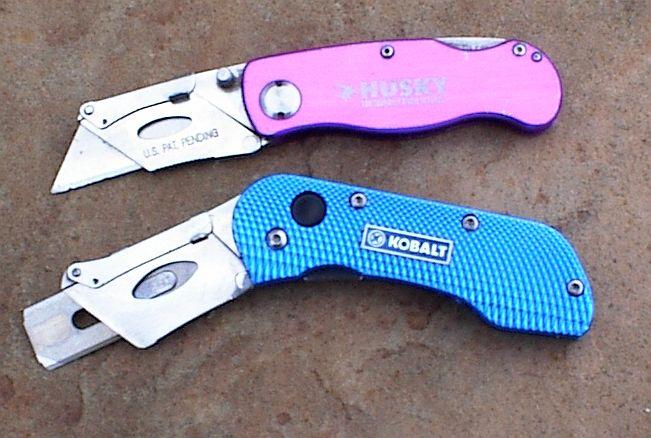
The folding utility knife is nothing new - its been around for awhile, with some pretty good quality ones having come out in the past couple of years. I think the first one I was aware of was the SuperKnife, which is probably still the best quality of them on the market, but there are several different brands out there now. Including several, of essentially the same type, that are being logo-branded by tool companies like Husky, or Kobalt, and sold cheaply in big-box hardware stores like Lowes.
I've had one of these, a Husky labeled utility knife, for awhile now and use it to cut assorted stuff around my knife making shop. Its a good tool, well made with a solid lock and a comfortable handle.
Just yesterday at Lowe's I picked up a folding Carpet Knife, with the nice double-edged razor style blade. A liner lock, this. Good lockup too.

The "low-profile" non-weapon weapons aspect of these tools is obvious; as a more concealable successor to the venerable box cutter. I have actually carried mine in the non-permissive environment on a couple of occasions. Not my first choice, but it is an option.
The box-cutter (and similar utility knives: carpet knives, linoleum knives) have long been a favored "Street weapon". I've seen more than one homeless guy with one in his back pocket and read more than one news article about some poor sap who stepped around the wrong corner and got one to the face and throat. I recall one article about a guy who got his neck sliced open by a gang member, ran all the way to the hospital hands clamped around his neck, and lived. He was fucking lucky.
In the UK a common name for edged weapons is "Stanleys" thanks to the good old Stanley box-cutter.
There is probably not a one of us that doesnt remember the role of the meager box-cutter in the 9/11 attacks.
Going back even further, I remember an old article in Tactical Knives by Bob Kasper, in the Street Smarts column (back around 1996 I'd guess), talking about the "deadly box-cutter attack". In it he talked about one of the best defenses against that type of mad-slashing attack I have seen - Hands on your head (temple area), elbows in tight (sort of a double arm version of the "Flinch "ala SouthNarc), to protect your face and neck from the slashes with that bony structure, and delivering an explosive barrage of low-line kicks, trying to break your attackers structure down. You'll get cut - but where do you get cut? The arms, elbows not the face and neck.

Every time I go to town I see several people with these folding-box cutters clipped to their pocket, usually some form of the one I have labeled Husky. Not all of these folk are the working-man looking type, the sort who would have one. I've seen more than a few "gangsta" types with these in their pockets. For all the ones I see, I have to wonder - how many dont get seen, because they know better than to be seen?
These things may be cheap, but like the older style (and still prevalent) boxcutter, they are solid and vicious weapons in determined hands. Occasionally its good to remember that.
In our training sometimes its good to put aside those big rubber A/F trainers, and use something to add a little more spice and reality to the mix. Thats why I make that folding box-cutter trainer up there, and why I keep a couple for myself.
Put some lipstick on the front 3/4" and try your disarms on that and see how you fair.

Monday, May 16, 2005

The Crash Axe as a Tool of Terrorist Interdiction


Onboard most commercial aircraft are a selection of survival and rescue tools such as fire extinguishers, first aid kits, defibrillators and crash axes. Although the crew knows where such items are they are usually stowed behind unmarked panels that normally go unnoticed by passengers.
Most crash axes, although built to double as fire axes, are more along the lines of a hatchet in size, ranging between 16” and 20” long with a hatchet or tomahawk sized head. The smaller size allows them to be stowed easily and makes them easier to use inside the confines of an aircraft. Several types of FAA approved crash axes exist, but the average size envelope remains the same.
The two designs I have personally encountered are as follows: The first having a hatchet head, with a hammer on the reverse and a pry-bar extension protruding from the top, the second closely resembles the World-War II era “SPAX” military crash axe. This second axe is in fact much closer to the original SPAX in design than the current version manufactured by Ontario Knife Company, although the difference is mainly in the handles.
The value of these items as survival and rescue tools is well proven, documented and understood but there is another dimension to their usefulness. Although after the significant act of 9/11 the likelihood of further airline hijackings or incidents involving airplanes is reduced the possibility still exists. Lone extremists and “crazies” acting without direction from a group (save possibly the voices in their head) still can pose a threat. Airline related terror has had an extremely high international visibility in recent years and has a strong recognition level with the general public, making it an obvious and prominent choice for the lone actor.
The past has shown that successful crew (and passenger) intervention can play a large role in stopping would-be single terrorists from carrying out their intended action. Air marshals are on many flights but they are not on all of them, and their rigid and recognizable dress codes make them obvious and immediate targets, potentially leaving the aircrew and passengers to deal with any threat. If that threat resists strongly an extreme level of force may be needed to thwart their objective.
Without air marshals and their conventional weapons to counter a threat, unconventional approaches to adjusting the attackers attitude must be taken.
Of available unconventional tools onboard the aircraft the crash axe may be the best. Excellent performers inside close quarters small axes and hatchets are among the most devastating close proximity weapons.
Aircrews and even air marshals would do well to learn some simple and powerful methods of using these and other unconventional tools incase of emergency threat situations.
Some of the best practice available for axes and hatchets is to simply use them for utilitarian work around the home, garden and campsite. Learning to swing and cut with them efficiently and powerfully is the primary task.
Simple forehand and backhand strikes in X and cross + patterns should be learned. The objective of these patterns is to strike your opponent in a manner conducive to most effectively stopping his or her attack.
When using any weapon as capable of lethal force as an axe the need and priority should always be using the maximum force needed to stop the target. Generally this means breaking down the limbs (his ability to hold and use weapons) and then targeting the trunk of the body and the head/neck for effective stoppage of the central nervous system.
The X and + patterns of forehand and backhand striking are ideal for this process of taking the limbs/weapons and then stopping the threat if the attack continues. The blows can be applied in rapid succession one after the other to opposing sides of the body to make quick work of multiple strikes to the same limb or to alternate from lower to higher targets and vice versa.
The successful use of such an unconventional weapon will not be visually pleasant, but the alternative is simply unacceptable. If routinely training (even just mentally) for this situation preparing for the post-fight environment would be wise. Others, particularly passengers, may be quite upset despite the obvious positives of having successfully negated the terrorist, and preparations should be considered ahead of time for dealing with that. As well as emotional trauma, there is the risk of blood-borne pathogens contaminating anyone involved in the fight or even near-by when it happened. On people with no open wounds or sores of any kind washing immediately with warm water and disinfectant soap to remove fluids and kill any bacteria is required. Waterless disinfectant hand-cleanser may also be used, but should not be considered an equal substitution. If blood or other potentially infected fluids have gotten inside of the eyes or mouth immediately flush with pure water for several minutes. If any open wounds have been exposed to bodily fluids they must first be treated to stop bleeding, and then the wound must be cleaned, Betadyne or Providone Iodine are best if available. If better solutions are not available, flushing with clean water for several minutes will have to do. All exposed passengers and crew, especially those with oral, ocular or wound exposures, should seek immediate medical attention upon landing.
Although not on anyone’s list of “pleasant topics” considering and making preparations for use of the crash axe as a weapon of aircrew and passenger survival in the event of an otherwise un-thwarted terrorist attack is well worth doing. Such planning may never be needed, but it is better to be ready and never need it than to need it and never be ready. Extreme circumstances call for extreme measures.