Tuesday, November 18, 2008

A Proposed Guideline...

A Proposed Guideline for Tactical Medical Self-Care in the Civilian Environment:
by Morgan Atwood, © Not For Redistribution w/o Permission & Attribution

Overview:

In environments involving violent use of firearms, knives, and other weapons capable of inflicting life threatening penetrating trauma (which we might call Tactical Environments for lack of a better term), there exists a need for medical management guidelines specifically addressing the unique concerns of said environment. The military and police communities have addressed this with adoption of the military generated Tactical Combat Casualty Care guidelines. Recognition of the risk of injury in the tactical environment, and the need for improved, tactically sound, care methods for those engaged in violent encounters has slowly begun seeping into the civilian context of armed/self-protection minded citizens. What information exists, however, is generally gleaned from the documents and training created around the military/police contextual model, which differs significantly from that of the armed citizen engaged in self defense.
The civilian environment lacks the protections afforded by operating in small units which can provide suppressive fire to protect dedicated medics, and members of which generally wear body armor and protective equipment. Injury sustained in the civilian environment must be self stabilized, for lack of better options, until professional care arrives. The safety and security of the environment in which the care is delivered is also up to the individual most likely suffering the injury. The armed citizen is triple-tasked to negate active threats, use cover and effective fire (not volume) to secure themselves, and provide their own care for stabilization of a life threatening injury in the “Platinum 10-minutes” after it occurs. This demand for self-care is only heightened by the inevitable delay in arrival of emergency medical services, given response times and the need for police to declare a scene secured prior to EMS entering.
Meeting the needs of medical care in civilian engagements can be accomplished via the first two stages of Tactical Combat Casualty Care: Care Under Fire and Tactical Field Care. The third stage, Casualty Evacuation, is handled by the arrival of EMS, and is of far less concern than self stabilization in the immediate aftermath of violent penetrating trauma.

(Complete Document after the Jump:)
Monday, November 10, 2008

A New Beginning

For several years I operated a website and blog under the Combative Concepts header. As time went on, I begin to harbor more and more unhappiness over that moniker for a variety of reasons. Firstly, the name became extremely limiting. As things evolved and my interests and skills expanded, some of the territory I wanted to cover was outside the small area dictated by that name. Wilderness survival, hard-use outdoor equipment, and related concerns weren't necessarily "combative". Secondly, I wasn't the first the operate under that name, though I was unaware of that when I created the first dot com and blog.
After taking a few years off, I found myself with a new training group, and working on fresh ideas. The developmental path this group had ended up taking was very much an evolution of my thinking at the end of the Combative Concepts endeavor. I had, we had, created something new and it was time to move on from the restrictions of the past. Thus, BFE Labs was born.
The name came about in part thanks to Ian Wendt, of Special Circumstances, and his suggestion that a joking crack I had made would actually be a good name for this project.
The acronym BFE stands for "Bum Fuck Egypt", a generalized concept of anywhere that is pretty much nowhere - Isolated, alone, austere, and possible hostile. The exact environments we have in mind for most of the work we do.

I have moved a few of the old Combative Concepts entries into this new blog, and once the dot com is up and running will move some of the old CC articles over there as well. Anything dated earlier than 2008 is from the Combative Concepts era - It is dated, some of my thinking has grown since then, and the BFE group is headed into new directions. That said, a lot of it is still worth reading, in my opinion, and as such it remains available.

Thursday, March 30, 2006

Is Stainless Steel Good Enough for a Knife Blade?

As a knife-maker, and the moderator of knife (or knife related) forums for a few different internet bulletin boards over recent years, I very often hear people talking about high carbon steel being the only choice for a good knife. If they don’t say it directly, it is often something they have heard from someone else, saying something like “I was told if a steel doesn’t rust it wont make a good knife.”
Of course the up-shot of this is very often that stainless steel gets pandered, even unintentionally, and very good knives made of stainless are ignored or over looked. This is quite unfortunate, because the right stainless steel works extremely well.

I have a theory about this little phenomenon though - It is an issue of Carbon content.

Before we continue, let me establish a few “definitions”. Steel, in general, is divided up into two categories, and five subcategories that apply to the two main ones:

  • Simple Carbon Steel – Steel of all types with less than 13% Chromium content.
  • Stainless Steel – Steel of all types with more than 13% Chromium content.

Ø Very Low Carbon – Steel with up to 0.05% carbon content.

Ø Low Carbon – Containing 0.05 – 0.2%

Ø Medium Carbon – Containing 0.2 – 0.5%

Ø Medium-High Carbon – Containing 0.5 – 0.8%

Ø High Carbon – Containing 0.8% and higher

The higher the carbon content the better, but we’ll get to that momentarily.

Now, in the knife world the term “High Carbon” alone takes on its own meaning – it is used to indicate a high carbon, Non-Stainless, blade steel. Stainless, or high carbon stainless, is the commonly used term for stainless steel blades.

The old-school wisdom about blade-steels having to be High Carbon steel probably comes from a combination of two things - early stainless steels having low carbon content (a hypothesis on my part, I am not a historical metallurgist), and cheap knives being made from poor (low carbon content) stainless steels.

You have a historical precedent of old-school bladesmiths and knife-makers saying "That new fangled stainless doesn’t make a good knife", combined with a current perception of stainless as a poor steel thanks to low quality knives. Although the latter is primarily supported by el cheapo Pakistani and Chinese imports, major companies such as Buck, Case, the now defunct Schrade, and Gerber, who are to a large extent makers of the knives carried by "the common man", use low grade stainless steels, that give poorer performance compared to the carbon steel of the knife the user may have carried before, or of a similar high carbon steel bladed offering.

Here's the difference between stainless and non-stainless (high carbon) steels, chromium. Anything less than 14% chromium, and its a carbon steel - over 14%, its not. That’s it. The chromium content has some impact on the quality of the steel as a knife blade, but comparatively little next to carbon content. Carbon content makes all the difference in the world. A good quality stainless steel, in addition to having the stain resistant (no steel is truly rust or stain "less") qualities provided by the Chromium content of the alloy, must also have a high carbon content.


Now, I am not a metallurgist, I’m just a knife-maker, but my understanding of this is as follows: Carbon is the essential element in hardening steel. When steel is heated to a certain temperature (this temp. will vary depending on carbon levels) the ferrite (pure iron) reacts with the carbides causing a transformation from the cold structure of the steel into a metastable state called austenite (a face centered cubic crystal with ample space for carbon atoms). As this critical temperature at which the change begins is passed more austenite pools and consumes the ferrite. When all the ferrite is consumed the steel consists of austenite and undissolved carbides. Without getting too involved here the transformation to austenite results in a new grain-structure, held by the undissolved carbides. As the heat is maintained at the critical temp (or increased for some alloys) the remaining carbide is dissolved, allowing the grain structure of the austenite to develop fully. Remember, this is a state of hot steel.
To harden, the steel in its austenite state is rapidly cooled (rapidly varies from steel to steel, and depending on the desired hardness, cooling is a controlled process, but to harden the cooling must be faster than natural heat dissipation by a considerable amount) – this cooling traps carbon atoms inside the face centered cubic structure which distorts them into a tetragonal shape that is under immense stress. This stress equals hardness. The end result of rapidly cooled austenite is called “martensite”. Without carbon, this entire process is impossible. Without the right amount of carbon, the process is possible but will never bring the steel to a hardness suitable for a knife.
(After all of the above, the hardening process, the steel is “tempered”, reheated slightly to relieve a little of the stress on the carbon atoms, and achieve a balance between necessary hardness, and toughness: the shock resistance of the steel. Too hard is also too brittle, not good for blades).
Other elements in the alloy, such as Chromium, Tungsten, Molybdenum, etc. can have their own little impacts on the hardening process, but without carbon its moot.

So how much carbon content is enough in Stainless Steel? Well, the lowest acceptable grade of stainless is generally considered 440A stainless, which has 0.60 carbon content, 440B has 0.70 and good old 440C has 0.95 – 1.20. Comparatively, 420J2 (which is the industry standard for Chinese junk knives) has only 0.15 – lending to the perception of stainless as a low carbon poor quality steel.
Industry standards for stainless tactical knives (especially at the custom level) are ATS-34, 154-CM and S30V.
ATS-34 and 154CM are pretty much the same steel although they differ in manganese content, one is simply a Hitachi product and the other from an American mill (Crucible, maybe, but I do not remember), their carbon content is the same 1.05
S30V has a carbon content of 1.45 (which is similar to the carbon content of top-end High Carbon tool steels, such as D2 [which is near a stainless, but just not quite enough Cr.]).
The best stainless blade steels are ones with a carbon content of 0.90 or greater. These steels are capable of achieving good hardness, for long term edge holding and performance, and if properly handled during hardening and tempering are also tough in addition to their wear resistance.

That’s a pretty quick (yeah right!) and dirty summation of how it works, so if there are any metallurgists here forgive me for any errors.

Folding Utility Knives


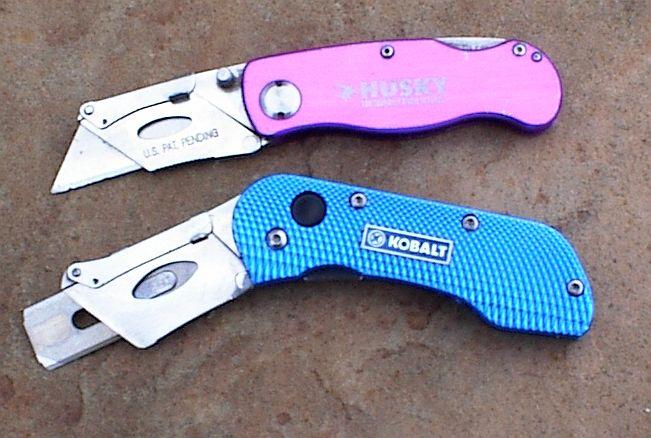
The folding utility knife is nothing new - its been around for awhile, with some pretty good quality ones having come out in the past couple of years. I think the first one I was aware of was the SuperKnife, which is probably still the best quality of them on the market, but there are several different brands out there now. Including several, of essentially the same type, that are being logo-branded by tool companies like Husky, or Kobalt, and sold cheaply in big-box hardware stores like Lowes.
I've had one of these, a Husky labeled utility knife, for awhile now and use it to cut assorted stuff around my knife making shop. Its a good tool, well made with a solid lock and a comfortable handle.
Just yesterday at Lowe's I picked up a folding Carpet Knife, with the nice double-edged razor style blade. A liner lock, this. Good lockup too.

The "low-profile" non-weapon weapons aspect of these tools is obvious; as a more concealable successor to the venerable box cutter. I have actually carried mine in the non-permissive environment on a couple of occasions. Not my first choice, but it is an option.
The box-cutter (and similar utility knives: carpet knives, linoleum knives) have long been a favored "Street weapon". I've seen more than one homeless guy with one in his back pocket and read more than one news article about some poor sap who stepped around the wrong corner and got one to the face and throat. I recall one article about a guy who got his neck sliced open by a gang member, ran all the way to the hospital hands clamped around his neck, and lived. He was fucking lucky.
In the UK a common name for edged weapons is "Stanleys" thanks to the good old Stanley box-cutter.
There is probably not a one of us that doesnt remember the role of the meager box-cutter in the 9/11 attacks.
Going back even further, I remember an old article in Tactical Knives by Bob Kasper, in the Street Smarts column (back around 1996 I'd guess), talking about the "deadly box-cutter attack". In it he talked about one of the best defenses against that type of mad-slashing attack I have seen - Hands on your head (temple area), elbows in tight (sort of a double arm version of the "Flinch "ala SouthNarc), to protect your face and neck from the slashes with that bony structure, and delivering an explosive barrage of low-line kicks, trying to break your attackers structure down. You'll get cut - but where do you get cut? The arms, elbows not the face and neck.

Every time I go to town I see several people with these folding-box cutters clipped to their pocket, usually some form of the one I have labeled Husky. Not all of these folk are the working-man looking type, the sort who would have one. I've seen more than a few "gangsta" types with these in their pockets. For all the ones I see, I have to wonder - how many dont get seen, because they know better than to be seen?
These things may be cheap, but like the older style (and still prevalent) boxcutter, they are solid and vicious weapons in determined hands. Occasionally its good to remember that.
In our training sometimes its good to put aside those big rubber A/F trainers, and use something to add a little more spice and reality to the mix. Thats why I make that folding box-cutter trainer up there, and why I keep a couple for myself.
Put some lipstick on the front 3/4" and try your disarms on that and see how you fair.

Friday, March 10, 2006

Desperate Circumstances call for Desperate Measures

In emergency situations no one thinks quite like they do normally. I've always been proud of myself for being a "cool head" when things are seriously going wrong but as I have read more and studied more about mental processes and particularly the decision making process under stress, and paid more attention to my own mind, even I know that the way I think under stress is not the way I think when I am calm, comfortable and safe.
Something I think a lot of people are prone to under stress is making decisions that, for a more immediate or easier reward, add a small, temporary, amount of risk to the situation.
At a certain point some additional risks bring about a greater benefit than not taking them - I can remember being 14 and driving 70 down a dirt road it could be dangerous to go 45 on, with my mom in the passenger seat apparently having a heart attack. It was a near-fatal potassium imbalance, as it turned out, but no less dangerous. There was risk to driving that fast, although the road was in good condition it was also un-predictable to a certain extent and not safe at higher speeds. There was also a greater risk if not driving fast - at a normal speed of 35mph its an hours drive to meet the ambulance. At 70, its half an hour. I knew I could handle the vehicle at 70, I wasnt an inexperienced driver. The risk, under the circumstances, was worth the reward.
But some risks arent.
People tend to say "desperate circumstances call for desperate measures" when faced with an emergency situation, as a way to justify driving a little faster or taking other additional risks for perceived gains - but it can be dangerous.
Tonight was the first night of the season we've needed to heat the house. This is a 60+ year old ranch house and is still dependant on wood-fired heat. For fun, and to at least encourage my skills, I built the fire somewhat by-hand, using a knife to break large kindling into splinters and make fuzz sticks and starting a little pile of shavings burning with some flakes off a magnesium block, then adding to it with larger pieces until I had a fire. Nice, cedar and pinon fire that went from a little bit of flame to a great roaring fire.
But, I had to stop myself at one point while I was splitting cedar into fine kindling. I caught myself slipping the knife blade under a large splinter and starting to pull it back towards my hand holding the piece of wood. The first lesson my dad ever taught me about a knife, when I got my first one at 6 years old, was to never cut toward myself. I've proved him right many times, and gone with him to the hospital when he proved himself extremely right one day a few years ago. I never want to cut myself, it sucks. As a knife-maker, I do it a lot, but it still sucks and I still dont like it. I like $1000.01 bills (the exact bill the last time I had stitches) for less than ten stitches even less.
But, it struck me, if I was really stuck somewhere miserable and cold (on a night like tonight, its still early fall but the temp has dropped fast and its snowing but earlier today I was out in short-sleeves), trying to build a fire, how much would I hurt myself to cut my hand, even minorly? How handicapped would I be with my hand cut, bandaged and maybe restricted or completely useless? What if I seriously injured myself, hit the artery in my arm, or slipped even further trying not to cut myself and stuck it in my thigh?
And would it have been worth it? No. It was taking a short-cut to something it would have only taken me a second longer to do right, turn the stick around and whittle the splinter off from a safe direction.
Easily learned lesson - no pain, no suffering. Most good lessons dont come so easily.
Desperate circumstances can call for desperate measures - but not stupid ones. Theres never an excuse for being stupid and dangerous.

Friday, March 3, 2006

"Women Should Be Dressed in White, Like Other Kitchen Appliances"

I think by now we've all heard the line that is this posts title, and know the stink it caused when the honcho of Formula 1 said it about, and to, Danica Patrick (Indy 500 4th place finisher). I'm not a racing fan, at all, and I heard it. If not, JFGI
What relevance does racing, or misogyny in that good ol' boys club have to self defense/combatives?
The former, not much, the latter? A lot.
Like a lot of male dominated fields, there is a lot of misogynistic behavior in the communities of firearms and combatives enthusiasts/practicioners/instructors.
Just recently on one of the forums I frequent there was a discussion that came up on what "women need to know" to successfully protect themselves. Several of the comments were less than heartening....
"Bring her man with her..."

"The most important thing a woman needs to know? The PIN number to the debit card."
This is, sad to say, typical.
This field is, pretty much, a boys club - particularly when we start talking about the serious innovators, those who work and train hard and distill the best, most cutting edge, software from their experience and study.
Now, most of these gentlemen, are just that - Gentlemen. But, theres the occasional internet poster, or range officer, or gun-store clerk who has the "Women should be dressed in white, like other kitchen appliances attitude."
And generally, even those of us who do not like that attitude, we ignore it. We dont call people on it, dont make waves.
The problem with that is when our daughters, wives, mothers, or girlfriends run into that attitude - on one of the boards we post on, and have encouraged them to visit, or in a gun store or at a range. Especially if they are new to the whole thing, just getting their feet wet, and maybe already a little bit uncomfortable.
That kind of attitude can be like running into a brick wall - If it was just starting to get interesting, or fun, one nasty run in like that can end the fun.
It just takes once, and the whole thing is over - you wont get her to go back to the range, or back on the board, again.

We may think its funny - But the women in our lives dont. I can be a sexist bastard just jokingly (I laughed at the "Women should be dressed..." comment), but not around my girl.
Frankly, any woman who puts up with our shit, deserves better - especially if she is beginning to accept her responsibility to protect herself, and expressing an interest in learning more about it.
Sexism, misogyny, even in fun, has no place in serious discussion, or training, involving women.
There's some real pieces of shit out there, who want to do horrible things to our queens. The ladies in our lives need every chance they can have, to get every advantage they can get.

Now, in answer to the "Whats the most important thing for a woman to know question", here is an excellent comment from James Yeager of Tactical Response:
"That it is just as right and just for her to defend herself as it is to defend her children."

Monday, May 16, 2005

The Crash Axe as a Tool of Terrorist Interdiction


Onboard most commercial aircraft are a selection of survival and rescue tools such as fire extinguishers, first aid kits, defibrillators and crash axes. Although the crew knows where such items are they are usually stowed behind unmarked panels that normally go unnoticed by passengers.
Most crash axes, although built to double as fire axes, are more along the lines of a hatchet in size, ranging between 16” and 20” long with a hatchet or tomahawk sized head. The smaller size allows them to be stowed easily and makes them easier to use inside the confines of an aircraft. Several types of FAA approved crash axes exist, but the average size envelope remains the same.
The two designs I have personally encountered are as follows: The first having a hatchet head, with a hammer on the reverse and a pry-bar extension protruding from the top, the second closely resembles the World-War II era “SPAX” military crash axe. This second axe is in fact much closer to the original SPAX in design than the current version manufactured by Ontario Knife Company, although the difference is mainly in the handles.
The value of these items as survival and rescue tools is well proven, documented and understood but there is another dimension to their usefulness. Although after the significant act of 9/11 the likelihood of further airline hijackings or incidents involving airplanes is reduced the possibility still exists. Lone extremists and “crazies” acting without direction from a group (save possibly the voices in their head) still can pose a threat. Airline related terror has had an extremely high international visibility in recent years and has a strong recognition level with the general public, making it an obvious and prominent choice for the lone actor.
The past has shown that successful crew (and passenger) intervention can play a large role in stopping would-be single terrorists from carrying out their intended action. Air marshals are on many flights but they are not on all of them, and their rigid and recognizable dress codes make them obvious and immediate targets, potentially leaving the aircrew and passengers to deal with any threat. If that threat resists strongly an extreme level of force may be needed to thwart their objective.
Without air marshals and their conventional weapons to counter a threat, unconventional approaches to adjusting the attackers attitude must be taken.
Of available unconventional tools onboard the aircraft the crash axe may be the best. Excellent performers inside close quarters small axes and hatchets are among the most devastating close proximity weapons.
Aircrews and even air marshals would do well to learn some simple and powerful methods of using these and other unconventional tools incase of emergency threat situations.
Some of the best practice available for axes and hatchets is to simply use them for utilitarian work around the home, garden and campsite. Learning to swing and cut with them efficiently and powerfully is the primary task.
Simple forehand and backhand strikes in X and cross + patterns should be learned. The objective of these patterns is to strike your opponent in a manner conducive to most effectively stopping his or her attack.
When using any weapon as capable of lethal force as an axe the need and priority should always be using the maximum force needed to stop the target. Generally this means breaking down the limbs (his ability to hold and use weapons) and then targeting the trunk of the body and the head/neck for effective stoppage of the central nervous system.
The X and + patterns of forehand and backhand striking are ideal for this process of taking the limbs/weapons and then stopping the threat if the attack continues. The blows can be applied in rapid succession one after the other to opposing sides of the body to make quick work of multiple strikes to the same limb or to alternate from lower to higher targets and vice versa.
The successful use of such an unconventional weapon will not be visually pleasant, but the alternative is simply unacceptable. If routinely training (even just mentally) for this situation preparing for the post-fight environment would be wise. Others, particularly passengers, may be quite upset despite the obvious positives of having successfully negated the terrorist, and preparations should be considered ahead of time for dealing with that. As well as emotional trauma, there is the risk of blood-borne pathogens contaminating anyone involved in the fight or even near-by when it happened. On people with no open wounds or sores of any kind washing immediately with warm water and disinfectant soap to remove fluids and kill any bacteria is required. Waterless disinfectant hand-cleanser may also be used, but should not be considered an equal substitution. If blood or other potentially infected fluids have gotten inside of the eyes or mouth immediately flush with pure water for several minutes. If any open wounds have been exposed to bodily fluids they must first be treated to stop bleeding, and then the wound must be cleaned, Betadyne or Providone Iodine are best if available. If better solutions are not available, flushing with clean water for several minutes will have to do. All exposed passengers and crew, especially those with oral, ocular or wound exposures, should seek immediate medical attention upon landing.
Although not on anyone’s list of “pleasant topics” considering and making preparations for use of the crash axe as a weapon of aircrew and passenger survival in the event of an otherwise un-thwarted terrorist attack is well worth doing. Such planning may never be needed, but it is better to be ready and never need it than to need it and never be ready. Extreme circumstances call for extreme measures.